

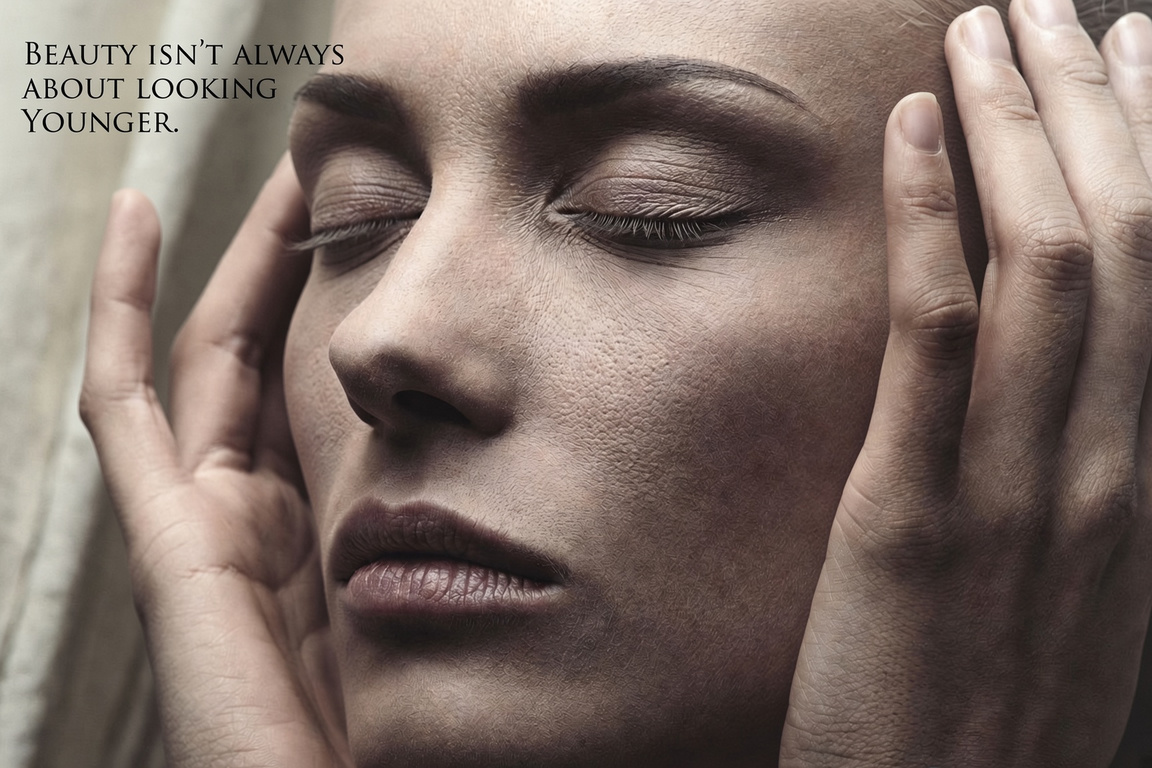
Forget the endless pursuit of a sharper jawline. A growing interest in facial massage suggests that beauty's next big luxury might be something far more human: the ability to relax.
For years, the beauty industry has been obsessed with one question: How can we make our faces look younger?
Fewer wrinkles. Tighter skin. Higher cheekbones. A more defined jawline.
Every new product, device, and treatment seemed to promise another way to turn back the clock.
But something interesting is happening in American beauty studios.
People are booking facial massages. And they're not necessarily coming in search of a facelift without surgery.
They're coming because their faces feel tense. Because their jaws are tight. Because they've spent another exhausting day staring at screens.
And perhaps because, for once, they want a beauty treatment that asks them to do absolutely nothing.
Could facial massage be moving beyond anti-aging and becoming something much more meaningful?
The Facial Massage Boom: What's Happening in America?
On October 16, 2026, Axios reported on the growing interest in facial massage, highlighting a shift in how American consumers experience this traditionally beauty-focused treatment.
One of the specialists featured was Christina Snead, an esthetician based in St. Louis Park, Minnesota.
Four years ago, Snead performed approximately two or three facial massages per week. Today, she sometimes provides as many as 20.
That's a remarkable change for one studio, although it shouldn't be mistaken for a nationwide growth statistic.
Her approach combines warmed gua sha stones, hands-on facial massage, and cooling stones to finish the experience.
Clients describe feeling lighter and less puffy afterward. Some report a surprisingly emotional response to the treatment.
Meanwhile, London-founded FaceGym is continuing its American expansion. At the time of the Axios report, the company had seven US locations, with two more planned.
These developments suggest that facial massage is attracting attention beyond the traditional facial-treatment menu.
But perhaps the most revealing part of this story isn't how many people are booking.
It's why they want the experience in the first place.
Your Face Is Not Just Something to Look At. It's Something You Feel.
Think about what happens to your face during an ordinary working day.
You concentrate. You frown. You squint at a screen. You tighten your jaw without noticing. Your forehead becomes tense as another notification appears.
Facial muscles are involved in expression, chewing, speaking, and many of the small movements we barely register.
And while not everyone experiences facial tension, some people become acutely aware of tightness around the jaw, temples, and forehead.
These sensations aren't necessarily signs of aging.
They can simply be part of how a person experiences a demanding day.
That's where the appeal of facial massage begins to make sense.
Instead of focusing exclusively on what the face looks like, the treatment invites us to notice what it feels like.
A gentle movement across the forehead. Slow pressure along the cheeks. Comfortable, rhythmic contact around the temples.
For someone who spends much of the day in a state of constant activity, the experience can feel like a welcome interruption.
And unlike a facial serum or an LED mask, professional massage involves something that technology cannot entirely replicate: responsive human touch.
The New Luxury? Doing Absolutely Nothing.
Modern wellness has become surprisingly demanding.
Count your steps. Track your sleep. Optimize your morning routine. Monitor your recovery. Improve your skin. Measure your biological age.
Even relaxation can start to feel like another project.
Facial massage offers a different proposition.
You don't need to achieve a personal best. You don't have to follow a screen, complete a workout, or measure your progress.
You simply lie down.
For the duration of the treatment, someone else takes care of the details.
Perhaps this is one reason facial massage fits naturally into the wider conversation about wellness.
Its appeal isn't necessarily about transforming the face.
Sometimes, it's about allowing the person behind that face to stop performing.
What Does Science Actually Say About Facial Massage and Relaxation?
Here's where the conversation becomes interesting.
There is some scientific evidence that facial massage may influence how people feel, although the research remains relatively limited.
A 2008 study published in Biomedical Research investigated the effects of a 45-minute facial massage on 32 healthy women.
Researchers observed reductions in reported anxiety and negative mood after the treatment, alongside changes in autonomic nervous system activity.
The results suggested that facial massage might have a refreshing psychological effect.
However, the study was small and cannot establish long-term mental health benefits.
A separate 2020 randomized study on massage and relaxation explored how brief massage sessions compared with resting.
Participants reported greater relaxation and less stress during the experiment, but the resting control group also experienced improvements. Importantly, that study examined neck and shoulder massage, not facial massage.
Taken together, these findings offer a reasonable explanation for why someone might feel calmer after a hands-on treatment.
But they do not prove that facial massage treats anxiety disorders, permanently lowers stress hormones, or resets the nervous system.
The science is still developing. The experience of relaxation, however, does not have to be a medical miracle to be valuable.
What Facial Massage Can — and Cannot — Actually Do
Let's address the question that dominates social media.
Can facial massage really lift your face?
The answer is less spectacular than some viral before-and-after videos suggest.
What Facial Massage May Offer
Depending on the technique, pressure, and individual response, facial massage may provide:
- A pleasant sense of relaxation and physical comfort.
- Temporary relief from the sensation of facial muscle tension.
- Short-lived changes in the appearance of puffiness for some people.
- A feeling of freshness and improved awareness of facial tension.
- An enjoyable addition to a personal wellness routine.
Some small studies have also investigated changes in facial circulation, skin elasticity, and facial measurements.
But the findings are not yet strong enough to support broad claims of permanent facial rejuvenation.
What It Cannot Promise
Despite what some beauty influencers suggest, there is no convincing clinical evidence that ordinary facial massage can permanently reposition facial fat, eliminate deep wrinkles, reverse the biological aging process, or replace surgical lifting procedures.
And the idea that a five-minute massage can completely reshape your face should be approached with skepticism.
A face may look temporarily refreshed after treatment. That is not the same as permanently changing its anatomy.
But here's a better question.
Why have we been measuring the value of facial massage almost exclusively in millimeters and wrinkles?
If a treatment helps someone feel comfortable, cared for, and relaxed, perhaps that experience deserves attention too.
Gua Sha, Facial Rollers, and the Return of Hands-On Beauty
Of course, this wellness conversation isn't happening in isolation.
Over the past several years, facial rollers and gua sha tools have become familiar features of beauty routines and social media videos.
Gua sha has roots in traditional Chinese medicine, although gentle contemporary facial applications differ from some traditional body techniques.
Its modern beauty popularity is often associated with sculpting, drainage, and improved facial contours.
According to Cleveland Clinic, facial gua sha may help with circulation and temporary puffiness, but high-quality scientific evidence for many popular claims remains limited.
The popularity of these tools also points to something interesting about contemporary self-care.
People are looking for rituals they can feel.
A gua sha stone gliding gently across the cheek. A cool roller moving over the forehead. A few quiet minutes before bed.
The ritual may be as important to the user as the cosmetic result.
Can Five Minutes of Facial Massage Make a Difference?
A short at-home routine may be a pleasant way to unwind.
Start with clean hands and clean tools, if you're using them. Apply a suitable moisturizer or facial oil to reduce friction, and use gentle movements rather than aggressive pressure.
There's no need to scrape hard, stretch the skin, or chase redness.
If your skin is irritated, sunburned, inflamed, or injured, it's better to skip massage until it has recovered. Certain medical conditions and treatments may also require professional advice.
And if something hurts, stop.
A relaxing routine shouldn't become another form of punishment in the name of beauty.
Why Professional Facial Massage Still Matters
If anyone can buy a jade roller online, why book a professional facial massage?
Because a tool and a treatment aren't necessarily the same experience.
An experienced practitioner can adjust pressure, rhythm, positioning, and the sequence of movements according to the client's comfort and needs.
Some clients prefer gentle, flowing movements. Others may enjoy carefully selected techniques focused on areas where they perceive tension.
Professional facial massage can also involve attention to the scalp, neck, and surrounding areas, depending on the treatment and the practitioner's qualifications.
But perhaps the biggest difference is the environment.
A thoughtfully designed treatment creates a space in which there is nothing to accomplish.
No mirror to inspect. No performance to measure. No algorithm asking for attention.
Just time, touch, and the opportunity to rest.
That's not an argument that professional massage is medically necessary.
It's an acknowledgment that the value of a wellness experience is not always reducible to its visible cosmetic outcome.
Is Facial Massage Becoming Part of the Slow Beauty Movement?
For decades, beauty advertising has encouraged us to see aging as a problem requiring increasingly urgent solutions.
Every wrinkle becomes a concern. Every change in facial shape becomes something to correct.
Facial massage has certainly participated in this narrative, particularly when marketed as a natural facelift.
But the growing wellness conversation offers an alternative.
What if beauty didn't always have to be about correcting something?
What if a treatment could simply be enjoyable?
What if looking after your face meant paying attention to how you feel, rather than constantly examining what needs improvement?
This perspective fits with the philosophy often described as slow beauty: an approach that values intentional routines, personal well-being, and a less frantic relationship with appearance.
Of course, not every consumer seeking facial massage is motivated by these ideas. Some are still primarily interested in lifting or sculpting.
And that's perfectly reasonable.
The interesting shift is that the reasons for choosing a facial treatment may be becoming more varied.
The Future of Facial Massage Isn't Just About Faces
The Axios story offers a glimpse into an evolving conversation about beauty and wellness.
It does not prove that facial massage is America's fastest-growing treatment, and it does not establish dramatic new therapeutic benefits.
What it does reveal is a compelling tension between two ways of thinking about beauty.
One asks: How can I change the way my face looks?
The other asks: How can I change the way I feel in my own skin?
Those questions don't have to compete.
You can enjoy the appearance of refreshed skin and appreciate the calming experience of a massage. You can care about your facial contours without turning every treatment into a battle against aging.
Perhaps the most meaningful evolution of facial massage isn't a revolutionary new technique or a more expensive sculpting tool.
Perhaps it's the permission to enjoy a beauty treatment without demanding that it transform you.
In a culture obsessed with looking younger, there is something quietly radical about choosing to feel better instead.
Maybe the future of facial massage isn't about turning back time.
Maybe it's about giving ourselves a little of it back.
Sources & Further Reading
- Axios (October 16, 2026). Face it: Massages aren't just for your back anymore. Read the original article.
- Hatayama, T., et al. (2008). The facial massage reduced anxiety and negative mood status, and increased sympathetic nervous activity. Biomedical Research, 29(6), 317–320. PubMed — DOI: 10.2220/biomedres.29.317.
- Meier, M., et al. (2020). Standardized massage interventions as protocols for the induction of psychophysiological relaxation in the laboratory: a block randomized, controlled trial. Scientific Reports. Full-text scientific publication.
- Cleveland Clinic (September 18, 2025). Gua Sha: What It Is and How To Do It. Read the medical overview.
- National Center for Complementary and Integrative Health (NIH). Massage Therapy: What You Need To Know. Read the evidence and safety guidance.
Editorial note: This article discusses facial massage as an aesthetic and wellness practice. It does not present facial massage as a treatment for anxiety disorders, chronic pain conditions, or other medical concerns.