
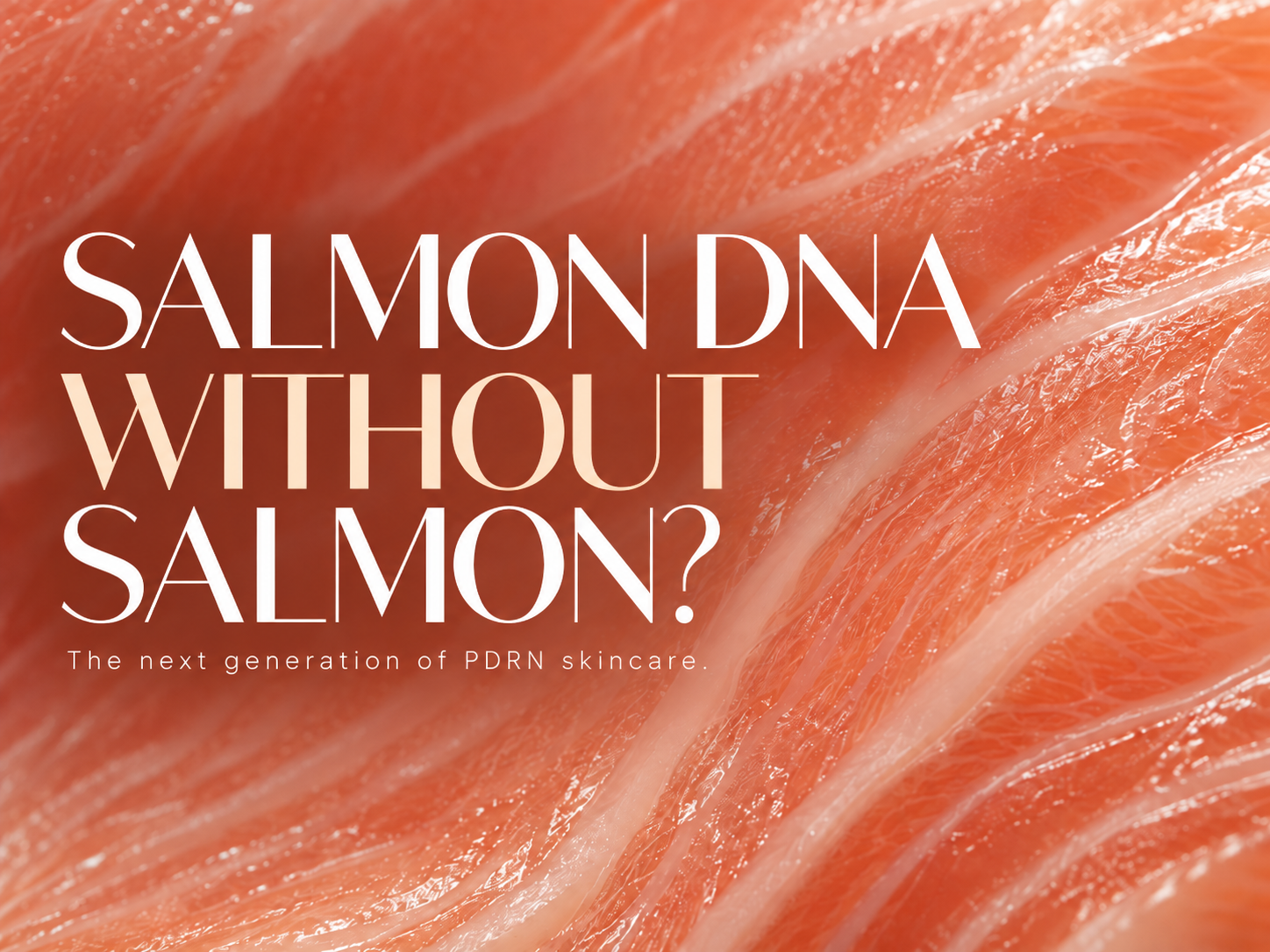
Salmon DNA Without Salmon? Why Recombinant PDRN Could Change One of Skincare’s Biggest Trends
“Salmon DNA” has become one of the strangest — and most successful — phrases in modern skincare.
Only a few years ago, most consumers had never heard of PDRN. Today, serums, creams, masks and aesthetic treatments built around polydeoxyribonucleotides are appearing across K-beauty, professional skincare and the wider global beauty market.
The ingredient is usually associated with DNA fragments obtained from salmon or trout.
But now something unexpected is happening.
The next generation of PDRN skincare may not need salmon at all.
In September 2026, cosmetic ingredient company Uniproma attracted industry attention after its PDRN Soothing Repair Cream, formulated with animal-free recombinant PDRN, was shortlisted in the Technology & Disruption category of the 2026 Laura Marshall Award for Innovation, presented within the UK cosmetic science industry. (Uniproma’s recombinant PDRN cream shortlisted for 2026 Laura Marshall Award)
The significance is not the award itself. Being shortlisted is not evidence that a skincare product works.
What makes the development interesting is the technology behind it.
Instead of relying on conventionally animal-derived PDRN, recombinant biotechnology is being used to create an animal-free source designed for use in cosmetic formulations.
And that raises a much bigger question:
If “salmon DNA” can now be produced without salmon, what exactly is PDRN — and how much of its skincare reputation is science rather than marketing?
First: What Is PDRN?
PDRN stands for polydeoxyribonucleotide.
Despite the dramatic “salmon DNA” nickname often used on social media, PDRN is not a mysterious substance extracted as an intact piece of a fish’s genetic identity.
It consists of purified DNA-derived fragments.
Traditionally, PDRN used in medical and aesthetic applications has commonly been obtained from the sperm cells of salmonid fish such as salmon trout and chum salmon. Scientific literature describes PDRN as DNA polymers that can vary considerably in molecular size depending on preparation and processing. (review of PDRN as a skin anti-aging agent)
Interest in PDRN did not begin with TikTok skincare.
The substance has been studied for years in connection with tissue repair, wound healing and regenerative medicine.
Research has investigated several possible mechanisms, including activation of adenosine A2A receptors and the supply of nucleotides through biological salvage pathways. These pathways may influence processes involved in inflammation, tissue repair, angiogenesis and cellular activity.
That biological background is one reason PDRN has become so attractive to the beauty industry.
Skincare has been moving away from the older idea of simply “erasing wrinkles” and toward language such as repair, regeneration, resilience and skin longevity.
PDRN fits almost perfectly into that story.
Why Does Everyone Call It “Salmon DNA”?
Because it is memorable.
“Polydeoxyribonucleotide” is hardly a phrase destined to go viral on social media.
“Salmon DNA” is.
The shorthand helped transform what was once a relatively technical regenerative ingredient into a beauty trend consumers could immediately recognise.
But the nickname can also create confusion.
People may assume that every PDRN product contains exactly the same material, works in exactly the same way or provides the same effects as an injectable aesthetic treatment.
None of those assumptions should automatically be made.
Different products may contain different forms, molecular sizes, concentrations and delivery systems.
And perhaps most importantly:
Injecting a substance into tissue and applying it to the surface of the skin are not the same biological situation.
The Evidence for PDRN Is Promising — But Smaller Than the Hype
There is genuine scientific interest in PDRN and related polynucleotides.
A 2026 systematic review examined randomized clinical trials involving polynucleotide and PDRN treatments for skin rejuvenation, postoperative scar prevention and wound healing. (2026 systematic review of randomized PDRN/PN trials)
Seven randomized trials involving 183 participants met the researchers’ inclusion criteria.
The studies reported improvements across several outcomes, including wrinkle-related measures, scar quality and wound healing. The most consistent results appeared in wound-healing applications.
But the authors also highlighted the major problem with the evidence base: the studies were small, protocols varied substantially and outcome measures were inconsistent.
Their conclusion was promising rather than definitive: larger and better-powered randomized trials are still needed.
That distinction matters enormously.
There is a difference between saying:
“PDRN has interesting regenerative evidence.”
and saying:
“Any cream containing PDRN will regenerate your skin.”
The first statement can be supported by an emerging body of research.
The second is much harder to defend.
Injectable PDRN and PDRN Skincare Are Not the Same Thing
This may be the single most important point for consumers to understand.
Much of PDRN’s reputation comes from research involving medical or aesthetic applications in which PDRN or related polynucleotides are delivered into or directly around tissue.
A topical cosmetic has another obstacle:
the skin barrier.
The stratum corneum exists specifically to prevent many substances from easily entering the body.
Large biological molecules therefore face a very different journey when placed in a cream compared with being delivered directly into tissue.
For years, that has been one of the key questions surrounding PDRN cosmetics:
Can sufficiently active forms of PDRN actually reach biologically relevant areas of the skin when applied topically?
Until recently, the evidence here was much less developed than the enthusiasm surrounding the ingredient.
Then a 2026 Study Made Topical PDRN Much More Interesting
In July 2026, researchers published a study in PLOS One examining a medium-length topical PDRN preparation called PDRN-850K in photodamaged skin. (2026 PLOS One study on topical PDRN-850K)
The research did not rely on a single experiment.
It included laboratory work with human dermal fibroblasts, reconstructed epidermal models, ex vivo tissue analysis, penetration studies and a randomized, double-blind split-face clinical study.
In the clinical part, a 0.1% PDRN-850K eye cream was compared with a 0.1% retinol product over 28 days.
The researchers reported improvements in measures including periocular wrinkles, dermal thickness, density and eye-bag parameters, with the PDRN formulation performing strongly in the study.
That is important.
It means the discussion around topical PDRN can no longer simply be dismissed with:
“DNA molecules are too large, so skincare PDRN cannot possibly do anything.”
The science is becoming more nuanced.
But there is an equally important warning.
This was one particular PDRN preparation, at a particular concentration, in a particular formulation, studied for a relatively short period. The clinical portion involved 31 Chinese women aged 35–55 and lasted 28 days, so the findings are promising but should not automatically be generalized to every population or every topical PDRN product.
The results do not prove that every serum advertising “salmon DNA” will behave in the same way.
- Formulation matters.
- Molecular characteristics matter.
- Delivery matters.
- Concentration matters.
And one positive study does not make an entire product category scientifically interchangeable.
So What Is Recombinant PDRN?
This is where the latest development becomes particularly interesting.
Traditional PDRN has historically been associated with animal-derived material, especially salmonid fish.
Recombinant biotechnology offers another production route.
Uniproma describes its recombinant PDRN as animal-free, produced through biotechnology with the aim of delivering more consistent quality and scalable production for cosmetic applications. The company also says the ingredient has undergone in vitro and in vivo efficacy testing. (Recombinant PDRN Enters Premium Skincare: A New Milestone for Biotechnology)
Those claims should be understood for what they are: information supplied by the ingredient manufacturer, not independent confirmation that every finished cosmetic containing recombinant PDRN will achieve a particular clinical result.
Still, the technological shift itself is significant.
If recombinant production proves commercially successful, PDRN could begin separating from its famous “salmon DNA” identity.
And that could change the category in several ways.
Why Make PDRN Without Salmon?
The most obvious reason is sourcing.
Animal-free production may appeal to brands and consumers concerned about animal-derived cosmetic ingredients.
It can also potentially offer manufacturers greater control over production consistency and scalability.
Traditional extraction depends on biological raw materials.
Biotechnology aims to make production more controlled and reproducible.
That is particularly attractive to an industry where a viral ingredient can move from niche trend to global demand extremely quickly.
There is also a branding advantage.
The expression “salmon DNA” attracts attention, but it can repel some consumers just as easily.
An animal-free PDRN ingredient allows beauty companies to keep the regenerative biotechnology story while potentially removing one of the biggest psychological barriers associated with the category.
And there is an interesting irony here.
For years, “salmon DNA” helped make PDRN famous.
Now PDRN may become successful enough that it no longer needs salmon.
Does Recombinant Automatically Mean Better?
No.
This is another point where beauty marketing can move faster than science.
Words such as biotechnology, recombinant, regenerative, lab-engineered and bioidentical sound highly advanced.
But a sophisticated production process does not automatically guarantee a superior cosmetic result.
Consumers ultimately use a finished formulation — not an ingredient technology in isolation.
A product’s real-world performance depends on the characteristics of the active ingredient, its concentration, stability, delivery system, supporting ingredients and the formulation as a whole.
It also depends on what the product is actually claiming to accomplish.
A recombinant source may offer advantages in sourcing, consistency or manufacturing.
Those are meaningful technological benefits.
But whether recombinant PDRN produces better visible skin outcomes than conventionally sourced PDRN requires comparative evidence.
At this stage, those two questions should not be confused.
PDRN Is Also Part of a Much Bigger Beauty Shift
The popularity of PDRN makes more sense when viewed alongside what is happening across skincare as a whole.
For decades, anti-aging marketing was dominated by a relatively simple promise:
- reduce wrinkles and make the face look younger.
The new language is different.
- Repair the barrier.
- Support regeneration.
- Improve resilience.
- Protect cellular function.
- Promote skin longevity.
Peptides, growth-factor-inspired cosmetics, exosomes, NAD+-related products, senescence research and regenerative ingredients are all competing for attention within this new beauty vocabulary.
Some have much stronger evidence than others.
Some are still predominantly marketing concepts.
PDRN sits somewhere in the fascinating middle: there is credible biological and clinical research behind the category, while consumer skincare products are expanding faster than the evidence needed to evaluate every formulation.
That combination makes it almost perfect for the modern beauty market.
It is scientific enough to be exciting.
Complicated enough to sound futuristic.
And visual enough — thanks to the unforgettable “salmon DNA” label — to become viral.
What Should Consumers Look for in a PDRN Product?
The presence of the letters PDRN on a package is not enough to tell you whether a product is effective.
The more useful question is:
What evidence exists for this particular formulation?
Does the brand disclose what type of PDRN it uses?
Is the concentration stated?
Is there testing on the finished product rather than only on the raw ingredient?
Are the claims cosmetic and realistic, or are they borrowing language from injectable treatments and medical research?
Does the company provide human data?
And was the research independent, manufacturer-sponsored or performed only in laboratory models?
None of these questions automatically determines whether a product is good or bad.
But together they help separate meaningful formulation science from an ingredient name printed prominently on the front of a bottle.
What About “Salmon DNA” Facials and Injectable Treatments?
Consumers should also avoid treating topical cosmetics, professional treatments and injectable PDRN or polynucleotide procedures as one category.
The scientific literature on polynucleotides and PDRN includes different substances, preparations, concentrations and delivery methods.
A systematic review of polynucleotide use in aesthetic medicine found encouraging outcomes for skin texture, wrinkles and elasticity, but also described the overall quality of available evidence as low to moderate and called for more rigorous research and standardisation. (The Effectiveness of Polynucleotides in Esthetic Medicine: A Systematic Review)
A newer 2026 review reached a similarly cautious conclusion: the regenerative potential is real enough to justify further research, but the available randomized evidence is still limited.
That is probably the fairest way to describe PDRN today.
Promising does not mean proven for everything.
And “used in aesthetic medicine” does not mean “a cream provides the same effect.”
Is PDRN the Future of Skincare?
Possibly — but perhaps not for the reason TikTok made it famous.
The most important development may ultimately not be “salmon DNA” at all.
It may be the growing ability of biotechnology to create increasingly sophisticated cosmetic ingredients with controlled molecular characteristics, new production methods and more targeted biological functions.
Recombinant PDRN fits into that much larger story.
Beauty is moving closer to biotechnology.
Ingredient development is becoming more technically ambitious.
And the boundary between cosmetic science, regenerative research and longevity language is becoming increasingly difficult for consumers to navigate.
That puts greater responsibility on both brands and professionals.
At Face Master Academy, we believe new technologies should be approached with curiosity rather than either blind enthusiasm or automatic scepticism: understanding what an ingredient can realistically do is more valuable than simply following — or rejecting — the latest trend.
Because the future of skincare probably will contain more biotechnology.
The harder question is determining which technologies genuinely improve outcomes and which simply create better marketing.
The Bottom Line
So, can “salmon DNA” exist without salmon?
Yes — at least in the sense that animal-free recombinant PDRN is now being developed for cosmetic applications.
Does that make conventional PDRN obsolete?
Not yet.
Does PDRN have real scientific potential?
Yes. Research into PDRN and related polynucleotides suggests meaningful biological and regenerative effects, and recent studies are making topical applications increasingly interesting.
But does that mean every viral PDRN serum “regenerates” skin or delivers results comparable to injectable treatments?
No.
The science is not there yet.
And perhaps that is what makes this ingredient worth watching.
PDRN is no longer simply an unusual K-beauty trend built around the shock value of “salmon DNA.”
It is becoming part of a much bigger transformation in skincare — one where biotechnology, regenerative science and cosmetics are beginning to overlap.
The salmon may eventually disappear from the story.
PDRN probably won’t.