

Will AI Replace Beauty Professionals? What AI Skin Analysis Can — and Can’t — See
Artificial intelligence has just appeared in a place few people would associate with a skin consultation: the airport.
In September 2026, travel retailer Lagardère Travel Retail announced the deployment of Perfect Corp.’s AI-powered Skincare Pro technology at beauty retail locations in Prague Airport, Rome Fiumicino and Amsterdam Schiphol, with two more European airports expected to follow before the end of the year.
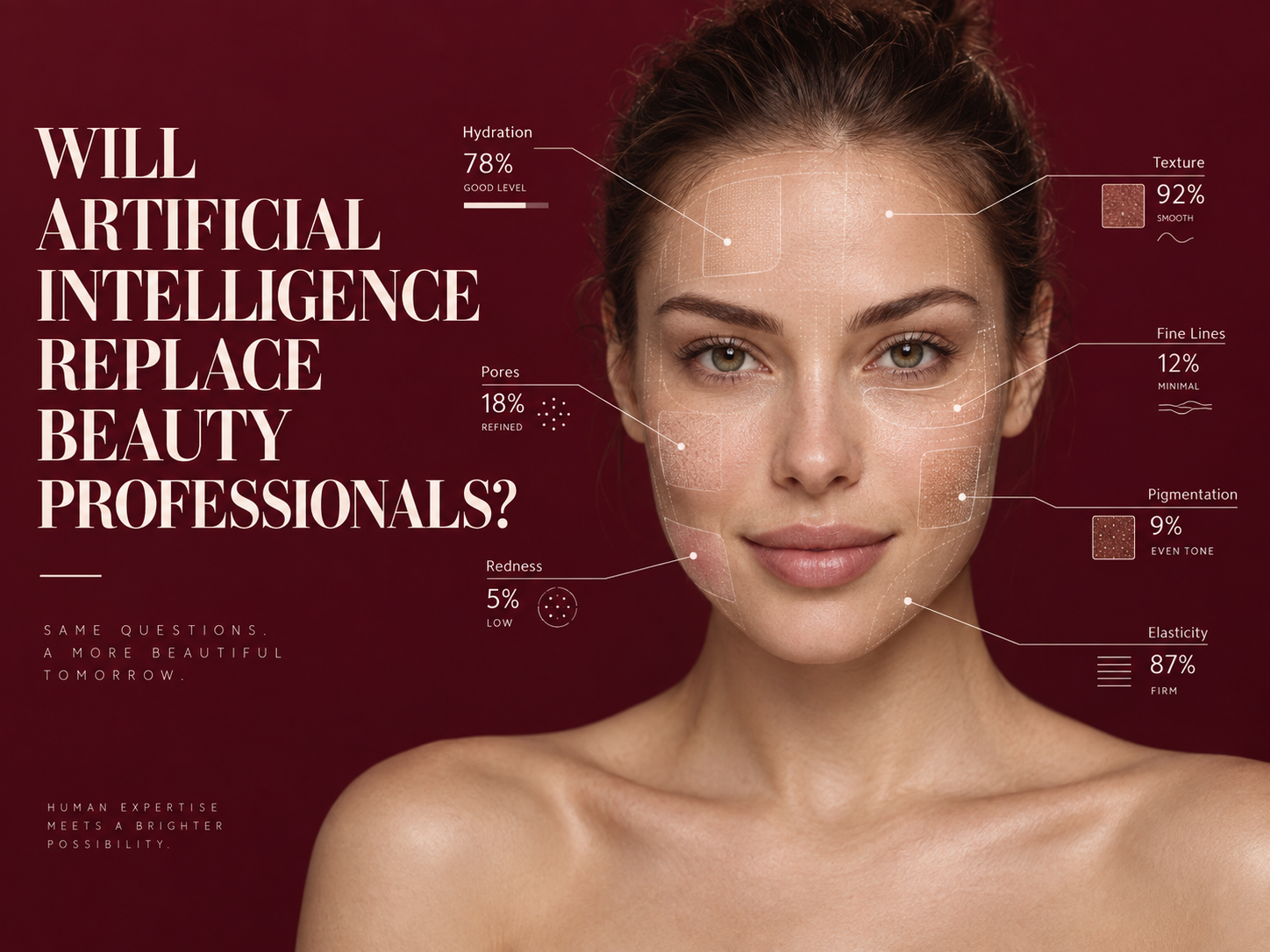
A traveler can have their face scanned and, within minutes, receive an analysis covering 12 visible skin concerns: wrinkles, pores, spots, texture, dark circles, redness, oiliness, moisture, eye bags, radiance, acne and firmness. The system can then suggest skincare products matched to those concerns. (Business Wire / Perfect Corp)
It sounds remarkably similar to part of a traditional skincare consultation.
Which raises a much bigger question:
If artificial intelligence can already analyse your skin in an airport in a matter of minutes, will we still need beauty professionals in the future?
The answer is more interesting than either “yes” or “no.”
Because AI is becoming genuinely powerful at analysing what a camera can see.
But skin — and the human face — are more than an image.
AI Skin Analysis Is No Longer Science Fiction
Artificial intelligence has been developing rapidly in dermatology because the field naturally contains a huge amount of visual information.
Photographs, dermoscopic images and other forms of imaging can be processed by machine-learning systems capable of identifying patterns and comparing them against enormous datasets.
A 2026 review of AI in clinical dermatology describes a significant shift: artificial intelligence is moving beyond proof-of-concept experiments into selected real-world applications, including image-based triage, lesion assessment and clinical workflow support. (PubMed)
Cosmetic dermatology is following the same direction.
Scientific reviews now describe AI being used for skin assessment, personalised skincare, three-dimensional facial analysis, treatment visualisation and monitoring changes in appearance over time. (PubMed / Journal of Cosmetic Dermatology)
What was once specialised technology available primarily in clinics is increasingly becoming accessible through retail systems, smartphones and consumer applications.
The airport skin scanner is therefore not an isolated curiosity.
It is a sign of where the beauty industry is moving.
What Does an AI Skin Scanner Actually See?
Most modern AI skin-analysis systems work by analysing digital images.
Depending on the technology used, they may evaluate visible characteristics such as:
- wrinkles and fine lines;
- pigmentation and dark spots;
- pores;
- redness;
- uneven texture;
- acne-related features;
- facial areas associated with dark circles or eye bags;
- visible signs associated with oiliness, dryness or skin ageing.
More advanced facial imaging systems can combine different lighting modes and image-processing techniques to reveal information that may be difficult to quantify consistently with ordinary visual inspection.
Computer-assisted facial imaging is already widely used in dermatology and medical cosmetology for quantitative evaluation of pigmentation, inflammation, vascular features, texture and signs of ageing. (PMC)
That word — quantitative — is important.
A human may look at two photographs and say, “The pigmentation appears slightly better.”
A computer can potentially compare pixel-level changes under controlled conditions and give a numerical assessment.
It does not get tired.
It does not have a bad day.
And, when the photography conditions are standardised, it can make repeated measurements in a highly consistent way.
That is a real advantage.
In Some Tasks, AI May See Things Humans Miss
Artificial intelligence is particularly good at pattern recognition.
Give an algorithm enough appropriately labelled images and it may detect relationships within visual data that are extremely difficult for a person to calculate manually.
This is one reason researchers are interested in AI not only for cosmetic evaluation but also for medical dermatology.
However, impressive performance figures need context.
A major 2026 clinical review stresses that “AI performance” cannot be reduced to one accuracy score. The result depends on what the system is designed to do, the population it was trained on, image quality, the device used, the clinical setting and what happens after the algorithm produces its result. (PubMed)
In other words:
AI can be extremely good at answering a narrowly defined question.
That does not mean it understands the whole person in front of the camera.
Skin Analysis Is Not the Same as Skin Diagnosis
This distinction may become increasingly important as consumer AI tools become more sophisticated.
An app that estimates visible wrinkles or suggests a moisturiser is fundamentally different from a medical system designed to identify disease.
Even highly advanced algorithms should not turn every smartphone into a dermatologist.
The American Academy of Dermatology has warned consumers to be cautious with apps claiming to diagnose skin diseases and stresses the importance of scientific testing, performance across different skin tones and appropriate professional evaluation. (American Academy of Dermatology)
The new airport system itself is positioned around skin analysis and product recommendations, not around replacing a dermatologist or diagnosing medical disease.
That distinction matters.
“Your skin appears red” and “this is why your skin is red” are not the same statement.
AI may be able to identify a visible feature.
Understanding its cause may require much more information.
So, Will AI Replace Estheticians and Beauty Professionals?
If the professional’s entire role consists of looking at a face and identifying visible pores, wrinkles and pigmentation, AI will increasingly compete with that part of the job.
And probably very effectively.
But high-quality professional assessment contains information that does not exist inside a photograph.
A trained professional may ask about:
previous procedures, home skincare, lifestyle, sensitivities, medications, recent changes, client goals and reactions to previous treatments.
They can observe the face during conversation rather than from one static frame.
Depending on their professional scope and training, they may also assess tissues manually through touch.
And this is where a camera reaches a fundamental limitation.
A Camera Cannot Palpate the Face
Consider two people whose faces look similar in a photograph.
The image may show comparable puffiness or similar facial contours.
But manual assessment may reveal very different tissue characteristics.
A practitioner can potentially assess differences in tissue mobility, tension, sensitivity, localised puffiness, facial movement and the way different areas respond to gentle manual contact.
The practitioner also sees how the face moves when the person speaks, smiles, frowns or relaxes.
A still image is a visual data set.
A face is a living, moving three-dimensional structure.
For professionals working with facial massage and manual aesthetic techniques, this difference is particularly important.
The question is not simply:
“What does the face look like?”
It is also:
“How does it move, how do the tissues feel, what does the client experience, what changed over time, and what is appropriate for this particular person?”
Artificial intelligence can add information to that assessment.
It cannot currently reproduce the entire assessment.
AI Has Another Problem: It Learns From the Data We Give It
There is also a less glamorous side to artificial intelligence.
Algorithms are only as representative as the data used to develop and validate them.
A recent systematic review and meta-analysis examining more than 70,000 test images found differences in the performance of AI dermatology systems between lighter and darker skin tones. In that medical skin-lesion literature, performance was lower in Fitzpatrick IV–VI skin than in Fitzpatrick I–III skin.
That research concerns dermatologic lesion classification rather than cosmetic airport skin scanning, so the results cannot simply be transferred to every beauty-analysis system.
But it demonstrates a broader problem that matters enormously for global beauty technology:
Who was represented in the training data?
Researchers in aesthetic dermatology have repeatedly identified the need for more diverse datasets representing different ages, ethnicities and skin characteristics before AI assessment can be considered universally reliable. (PMC)
This is especially relevant for technologies intended for a global market.
A system should not merely work beautifully on the people who happened to dominate its training database.
It needs to work reliably on the people who actually use it.
Even the Perfect Photograph Is Not Really “Perfect”
Another misconception is that a machine automatically produces an objective truth.
It does not.
Computer-assisted facial imaging can provide repeatable quantitative information, but scientific reviews show that results may still change because of lighting, facial position, camera angle, environment and operating technique. (PMC)
Anyone who has ever taken two selfies five minutes apart already understands the principle.
Lighting can dramatically change the appearance of:
- texture,
- shadows,
- under-eye areas,
- pigmentation,
- redness,
- and facial contours.
AI may analyse an image with extraordinary sophistication.
But if the input changes, the output can change too.
“Objective technology” still requires good methodology.
The Most Likely Future Is Not Human vs. AI
The beauty industry loves dramatic predictions.
Machines will replace professionals.
AI will replace consultations.
Algorithms will choose every product.
But the more realistic future may be much less dramatic — and much more useful.
AI will probably become another instrument in the professional toolkit.
A skin professional could use AI imaging to quantify visible changes.
Then use consultation, professional knowledge and hands-on assessment to interpret those findings within a much larger context.
AI can remember thousands of patterns.
A human can ask why the client suddenly changed their skincare routine three weeks ago.
AI can compare photographs.
A human can feel the tissues.
AI can calculate.
A human can listen.
The strongest system may therefore be neither artificial intelligence nor human intuition alone.
It may be AI-generated data combined with educated human judgement.
The Profession May Not Disappear — But Its Standards May Rise
There is an uncomfortable side to technological progress.
When a machine can perform a basic visual analysis instantly, charging clients simply for information that a consumer app can provide becomes harder to justify.
That does not make the beauty professional irrelevant.
It changes what expertise needs to mean.
Professionals will increasingly need to understand anatomy, skin physiology, contraindications, tissue behaviour, communication, manual assessment and the limitations of the technologies they use.
They will also need enough AI literacy to know when an algorithm is useful — and when its result should be questioned.
At Face Master Academy, we see this development not as a conflict between technology and manual practice, but as a reason for beauty professionals to deepen their knowledge: the more information technology can generate, the more important the ability to interpret that information becomes.
Final Thought: AI Can Analyse a Face. Understanding a Person Is Harder.
AI skin analysis is already impressive.
It will become faster, cheaper, more accessible and probably far more sophisticated over the next few years.
Ignoring it would be a mistake.
But confusing image analysis with complete professional assessment would be another one.
The real question is therefore not:
“Will AI replace beauty professionals?”
A better question is:
“Which beauty professionals will know how to work intelligently alongside AI?”
Because the technology is unlikely to stop improving.
And neither should the people using it.