

Lymphatic Drainage Facials Are Everywhere — But Do They Actually Sculpt Your Face?
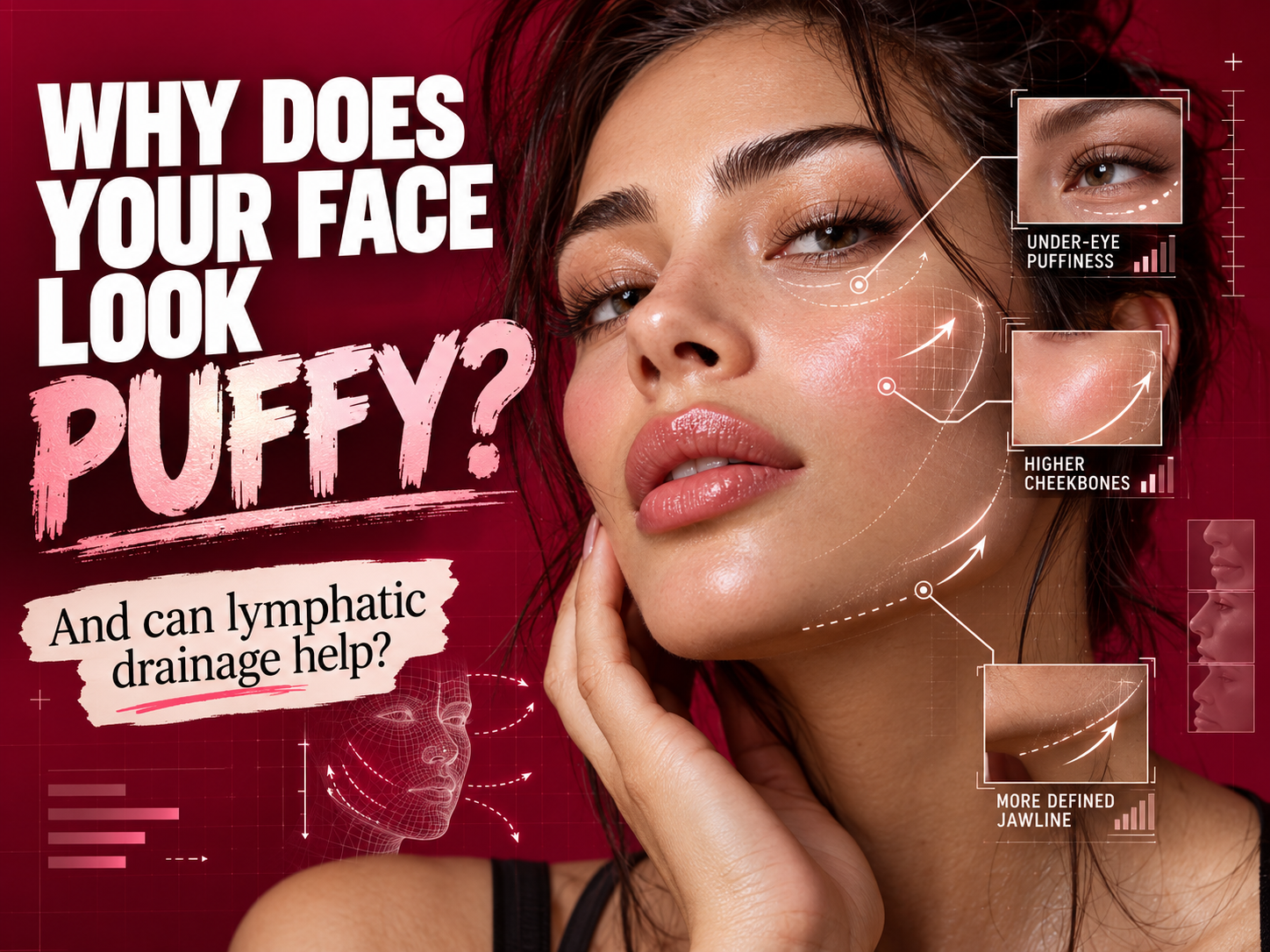
One face. Ten minutes. A noticeably cleaner jawline, lighter under-eye area and cheekbones that suddenly seem more defined.
It is easy to understand why lymphatic drainage facials have become one of the most talked-about beauty treatments on social media. (Women's Health — Lymphatic Drainage Facials)
Before-and-after videos can look surprisingly dramatic. And unlike many viral beauty trends, there is a very real reason why the face can look different after a well-performed lymphatic massage.
The secret is not “melting” facial fat or changing your bone structure.
It is something much more natural: fluid movement, reduced puffiness and the way soft tissues influence the contours we see in the mirror.
So what actually happens during a lymphatic drainage facial — and why can professional technique make such a visible difference?
Why a Puffy Face Can Look Like a Different Face
Our facial features are not defined by bone structure alone.
Skin, subcutaneous tissue, muscles, connective tissue and fluid all contribute to the way the face looks from one day to another.
That is why the same face can look noticeably different after poor sleep, a long flight, a salty dinner or simply first thing in the morning.
Even relatively subtle puffiness can soften the jawline, make the eye area appear heavier and reduce the visible definition of the cheekbones.
Reduce some of that excess fluid, and the natural architecture of the face becomes easier to see.
This is one of the reasons lymphatic drainage can create such satisfying before-and-after results.
What Is a Lymphatic Drainage Facial?
The lymphatic system is part of the body's fluid-balancing and immune systems. It includes a network of vessels and lymph nodes that help transport lymphatic fluid through the body.
Manual lymphatic drainage uses gentle, controlled and directionally specific movements to encourage fluid movement through this system.
This point matters.
A lymphatic facial is not supposed to be an aggressive massage.
In fact, more pressure does not automatically mean a better result.
Medical guidance from Cleveland Clinic describes lymphatic drainage as a light-pressure technique and notes that facial lymphatic drainage may help reduce puffiness and support circulation. (Cleveland Clinic — Lymphatic Drainage Massage)
The goal of a cosmetic lymphatic facial is therefore not to force the tissues into a new shape.
It is to work with the body's natural drainage pathways.
And when puffiness is masking the contours of the face, the visual difference can be significant.
So, Can Lymphatic Drainage Really Sculpt the Face?
Yes — visually.
But the word “sculpt” needs context.
When excess fluid decreases, the jawline may look clearer. Cheekbones may become more visible. The area under the eyes can appear lighter and the whole face may look fresher and more rested.
That is a genuine cosmetic change.
What lymphatic drainage does not do is remove facial fat or permanently change your bone structure.
And it does not need to.
One of the most interesting things about professional facial massage is that noticeable improvement does not always require aggressive intervention.
Sometimes revealing the face's existing contours is enough to create a visible transformation.
This distinction is important for both clients and facial massage professionals.
A skilled practitioner understands what is creating the visual change rather than simply promising a “lift.”
Why Professional Technique Matters
If lymphatic drainage is gentle, it may seem as though almost any soft massage should work.
But direction, sequence and pressure matter.
A professional treatment is not simply a collection of strokes across the face.
The practitioner considers where fluid needs to move, prepares the appropriate drainage pathways and works through the face in a logical sequence.
Cleveland Clinic's guidance on facial lymphatic self-massage also emphasizes beginning with the body's major drainage areas and using very light pressure. (Cleveland Clinic — How To Perform a Lymphatic Drainage Self-Massage)
This is one of the biggest differences between a technique and a trend.
On social media, we usually see the most visually interesting 20 seconds.
Professional training focuses on everything that happens before, during and after those 20 seconds.
- Pressure.
- Hand position.
- Direction.
- Rhythm.
- Skin preparation.
- Client comfort.
- Contraindications.
- And the ability to understand what the tissues are telling your hands.
Gentle Does Not Mean Ineffective
Beauty culture has spent years teaching us that stronger often means better.
Stronger acids. More intense treatments. Deeper pressure. More dramatic sensations.
Lymphatic techniques challenge that idea.
Because many lymphatic vessels are superficial, effective manual work is associated with light, controlled pressure.
This is exactly why pressing harder can miss the point of the technique.
A facial treatment does not have to hurt to feel effective.
In professional facial massage, the ability to control pressure is a skill in itself.
The practitioner needs to know when a technique should be light and rhythmic — and when another type of facial massage may require a completely different depth, tempo or purpose.
Lymphatic Drainage vs. Sculpting Facial Massage
These terms are often used interchangeably online, but they are not exactly the same thing.
Lymphatic drainage primarily focuses on fluid movement and puffiness.
A broader sculpting facial massage may combine several approaches depending on the technique and the client's needs.
This can include work with facial muscles, areas of tension, the neck, scalp and other soft tissues.
That is why an experienced facial massage specialist does not necessarily perform the same sequence on every face.
A face that looks heavy because of temporary puffiness is not approached in exactly the same way as a face with pronounced muscular tension, for example.
The most interesting results often come from understanding which technique the face actually needs.
Hands, Gua Sha, Rollers or Lymphatic Brushes?
Social media has given us an impressive collection of facial tools.
Gua sha stones.
Jade rollers.
Metal rollers.
Lymphatic brushes.
Ice globes.
And new devices appear constantly.
Tools can certainly become part of a beauty ritual. But a tool does not automatically understand anatomy, pressure or direction.
Hands offer something particularly valuable: feedback.
A trained practitioner can feel differences in tissue resistance, tension and movement while adjusting pressure in real time.
That does not make tools “bad.” It simply means that the tool itself is not the technique.
We explored this in more detail in Gua Sha, Facial Rollers and Hands: What Science Really Says.
Why Viral Before-and-After Results Can Look So Dramatic
There are several reasons.
First, a person who begins with noticeable facial puffiness has more visible potential for immediate change.
Second, small changes around the jawline and under-eye area can strongly influence how defined the entire face appears.
Third, massage is often performed on one side first for demonstration purposes. Comparing a treated side with an untreated side can make subtle differences much easier to see.
And, of course, camera angle, lighting and head position can exaggerate results online.
But that does not mean every visible difference is an illusion.
Reduced puffiness really can change the appearance of facial contours.
The more useful question is not:
“Is the before-and-after real?”
It is:
“What exactly created the change?”
That question separates professional understanding from beauty hype.
How Long Does the Effect Last?
There is no universal answer.
If facial puffiness is related to temporary fluid retention, the face can change again as sleep, hydration, diet, hormones and lifestyle change.
That is normal.
Facial massage is not designed to freeze the face in one permanent condition.
Regular professional treatments and appropriate self-care can become part of an ongoing beauty routine, just like skincare, exercise or hair care.
What matters is choosing realistic goals.
For many people, those goals are not “changing the face.”
They are:
looking less puffy,
feeling more relaxed,
supporting a fresh and rested appearance,
maintaining facial massage as part of a consistent beauty routine,
and enjoying a treatment that works with the face rather than aggressively against it.
Can You Do Facial Lymphatic Drainage at Home?
For many healthy people, gentle facial self-massage can become a useful beauty ritual.
But technique still matters.
One of the most common beginner mistakes is using too much pressure because stronger sensations feel more “effective.”
With lymphatic work, this logic does not apply.
A professional can teach you how to use your hands more intelligently instead of simply using more force.
This is also why learning the basics of touch is so valuable — even before learning a complete professional massage protocol.
At Face Master Academy, one of the first things beginner students study is not a complicated lifting sequence.
It is how to touch the face correctly.
When Should You Be Careful?
Facial puffiness is not always simply a cosmetic issue.
Persistent, unexplained or sudden swelling should not automatically be treated with massage.
Medical sources recommend avoiding lymphatic drainage in certain situations, including active infection, fever, blood clots and some heart or kidney conditions, among other contraindications.
People recovering from surgery, undergoing medical treatment or experiencing persistent swelling should follow the advice of their healthcare professional before beginning massage.
Professional facial massage training is therefore not only about learning what to do.
It is also about learning when not to do it.
The Bigger Beauty Trend Behind Lymphatic Drainage
The popularity of lymphatic facials tells us something interesting about where beauty is moving.
For years, the industry has focused heavily on stronger interventions and increasingly complicated routines.
Now another idea is becoming just as attractive:
working intelligently with the body's own structures and processes.
Facial massage fits naturally into that movement.
It is tactile.
Personal.
Non-invasive.
Highly adaptable.
And it creates something that technology often struggles to reproduce: human touch.
That does not mean facial massage replaces every other beauty treatment.
It means it occupies its own increasingly important space between skincare, wellness and professional esthetics.
And for many practitioners, that space is becoming a profession.
What If You Want to Learn Facial Massage — Not Just Receive It?
There is an interesting moment that happens to many people after discovering professional facial massage.
At first, they simply want the treatment for themselves.
Then they start asking different questions.
Why did the practitioner move in that direction?
Why was the pressure so light there?
Why did one movement immediately change the appearance of the face?
Could I learn to do this?
Could this become a professional skill?
And sometimes:
Could this become my new career?
If you are curious about facial massage from the practitioner's side, you do not need to commit to a large professional program immediately.
Face Master Academy created Face Master START UP, a free online practical course designed specifically for beginners.
The course includes 8 modules and introduces you to the profession step by step.
You will explore:
the role of a facial massage and esthetics professional,
skin cleansing and preparation,
8 essential hands-on techniques in the ABC of Touch lesson,
facial massage products,
how to choose professional skincare,
client experience,
common beginner mistakes,
your first steps into professional practice,
and the INFINITY Express Facial Massage technique.
The goal is simple:
to let you experience the profession before deciding how far you want to take it.
No previous professional experience is required.
Start Face Master START UP for free → learn the art of facial massage
The Bottom Line
Lymphatic drainage facials are popular because they respond to something many people can immediately see and feel: facial puffiness, heaviness and loss of definition.
A well-performed technique can help the face look fresher, lighter and more defined by supporting the movement of excess fluid.
But the most valuable lesson behind the trend may be bigger than the trend itself.
Facial massage is not simply about copying movements.
It is about understanding why a movement is performed, where it should go, how much pressure to use and what the face actually needs.
And that is where a viral beauty ritual becomes a professional skill.
About the Expert
Yulia Zinovyeva is a cosmetologist-esthetician, facial massage educator and founder of Face Master Academy, an international online academy specializing in aesthetic cosmetology, facial massage techniques and spa therapy.
Face Master Academy teaches students around the world to approach facial massage through anatomy, professional technique, intelligent touch and practical hands-on training.